The Gospel of Luke 17:5-10 The apostles said to the Lord, “Increase our faith!” The Lord replied, “If you had faith the size of a mustard seed, you could say to this mulberry tree, `Be uprooted and planted in the sea,’ and it would obey you. Who among you would say to your slave who has just come in from plowing or tending sheep in the field, `Come here at once and take your place at the table’? Would you not rather say to him, `Prepare supper for me, put on your apron and serve me while I eat and drink; later you may eat and drink’? Do you thank the slave for doing what was commanded? So, you also, when you have done all that you were ordered to do, say, `We are worthless
Let us Pray: Lord, give us faith—not in abundance, but in authenticity. Teach us to serve without seeking praise, to trust without needing signs, and to walk humbly in the path you’ve set before us. May we say, with joy and reverence, “We have only done our duty,” knowing that your grace is more than enough. This we pray in your name Father, Son and Holy Spirit. Amen.
When you plant a garden, you need faith that conditions will be right for the desired outcome. The garden needs a lot of care and attention. A garden is not unlike one’s faith. Our faith needs a lot of attention and care if it is to survive in today’s world. With so many things trying to guide us away from true faith it sometimes becomes a battle. If you are a true believer the choice is not difficult to make, but it might be difficult to sustain and develop. The mustard plant’s rapid growth symbolizes spiritual development, how faith, once planted, can flourish quickly and unexpectedly, but it takes faith to keep it flourishing. True spiritual growth is marked not by dramatic displays of faith, but by consistent, humble obedience. When the disciples believed their faith was insufficient to the responsibility they have to one another, they ask Jesus for more faith. His parable explained to the disciples how important even a little faith was. Using the mustard seed as an example of what a little bit of faith could do. it is worth noting that the disciples believe their faith is insufficient to the responsibility they have to one another. They want more faith to help them be accountable to each other. The plea is rooted in communal care and relationships. This was not a request from an individual undergoing a spiritual crisis. The disciples understood that they were dependent upon each other. They needed to know that they had the necessary tools to help each other, and they asked, but Jesus assured them with the parable of the mustard seed that even a little faith and trust in God could move mountains. As Jesus has done before he digresses into another topic to help the disciples to understand the way He wanted them to live. He used the example of the servant who worked all day and got no recognition He used this to dismantle any notion of entitlement in discipleship. His parable was to teach that disciples serve because it is our calling, not because we expect applause. It acknowledges that our service is a response to grace, it also invites us to serve quietly, faithfully, and without expectation of reward. God’s grace precedes our duty: The parable reminds us that we live in a kingdom where grace is the foundation, and duty flows from our faith to growing the Kingdom of God.
Let us Pray: You walked the road of humility, Teaching us that greatness lies in surrender. Help us not to measure our worth by what we accomplish, But by how faithfully we follow. Let our faith be lived in the ordinary— In kindness offered, in burdens shared, in prayers whispered. Make us servants who do not seek applause, But who delight in Your presence and purpose. Shape us into disciples who trust, obey, and love— Even when no one is watching. Amen.
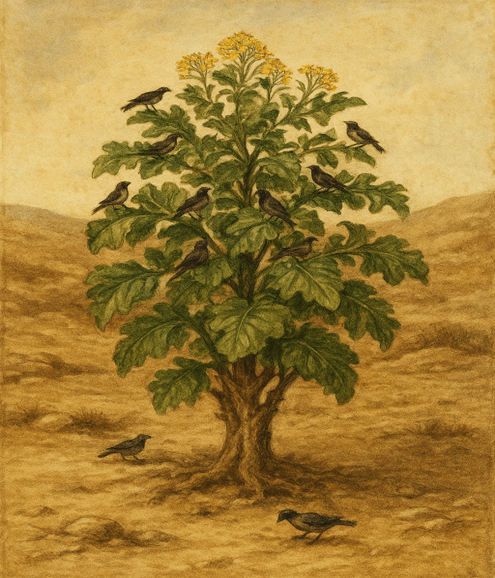
I added a little bit about the biblical mustard plant. The mustard plant in biblical times was much more than a humble herb—it was a vivid symbol of faith, transformation, and divine potential woven into the cultural and spiritual life of ancient Israel. Most scholars agree the biblical mustard plant was likely black mustard (Brassica nigra), known for its tiny seeds and rapid growth. It could grow up to 10–15 feet tall, with sturdy branches capable of supporting birds, aligning with Jesus’ parable in Mark 4:32. Mustard thrived in the arid, rocky soils of the region, making it a staple in subsistence Its seeds were used for culinary spice and medicinal remedies, treating ailments like digestive and respiratory issues. Farmers valued its resilience and versatility, as it required minimal care and grew quickly.
 Reflections by Bob